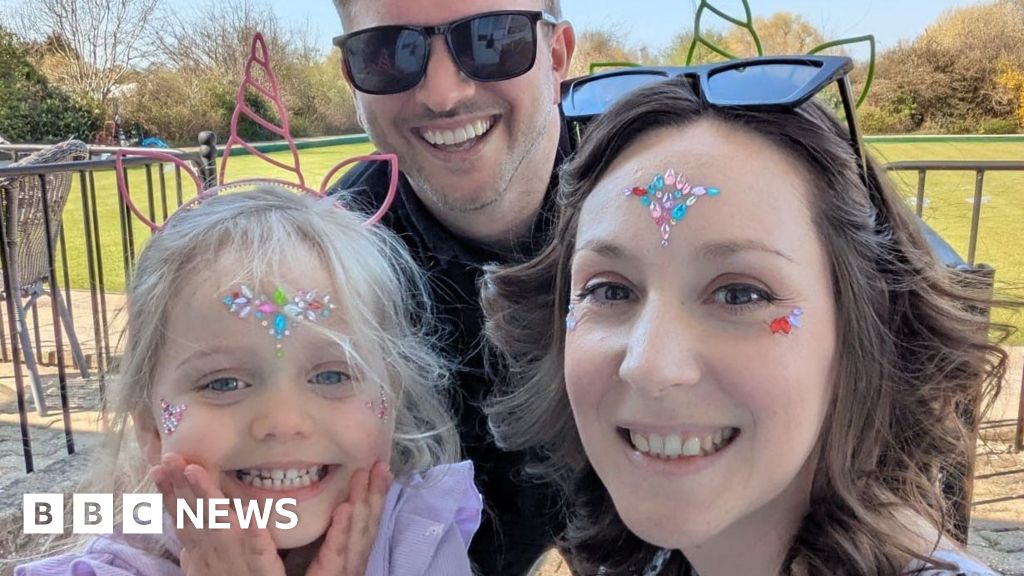
Grieving family welcome PM's brain cancer promise 57 minutes ago Hannah Walsh South of England Clare and Mark Grimley Seren was only four years old when she died due to a brain tumour A family whose daughter died from a brain tumour have welcomed Prime Minister Andy Burnham's promises for more investment into brain cancer research. Clare and Mark Grimley, from Bournemouth, Dorset, lost their four-year-old daughter Seren to a brain cancer, called an ependymoma, a year after she was diagnosed. Seren had brain surgery, learnt to walk again, went through proton beam therapy (PBT) and had a "really positive" end of treatment scan, before the tumour grew back within months.
The promises from Burnham, including a review of brain cancer progress, come after a meeting with Archie Goodburn, a commonwealth swimmer who has three inoperable brain tumours. The family described Seren as a "very girly girl" who "loved her princesses, loved her unicorns". She first started to display symptoms such as a headache, being lethargic and losing her balance in July 2025 and died a year later.
Seren was the 1000th patient to receive proton beam therapy at University College London Hospital Clare said: "It'd just been her fourth birthday, and we had gone on holiday to Devon. "We were at a caravan park, and she was at the children's disco one night, and another child ran into her, and she was complaining about having a headache, absolute beside herself crying." The family took Seren to A&E where it was initially thought her symptoms were a neck condition called Torticollis. However, over the following days Seren's symptoms worsened.
A CT scan revealed she had a brain tumour in the back of her head. She was rushed by ambulance to the specialist children's neurological ward at University Hospital Southampton (UHS) where an MRI scan showed the tumour was operable. Mark said: "She had 12 hours of brain surgery.
It was deemed an amazing success. The guys were absolutely incredible." When the tumour was confirmed to be cancerous, she was referred to University College London Hospital (UCLH) to undergo six weeks of PBT. In November 2025, Seren had her post-treatment scan and was then onto three monthly scans for at least two years.
But in May 2026, they showed her tumour had grown back and spread. Mark said: "It had got pretty big pretty. And it had grown into the brainstem.
"So within a three-month period, it had not only returned in the area that it had been treated, it had spread across the brain and spine." Clare said: "When she relapsed, there were no options for a cure, and that was just really shocking. Like no medications, chemotherapy wasn't an option. "We could have had the intracranial, but again, it would've just made her really poorly.
It wouldn't have cured her." Mark added: "All this would be kind of to buy time. "And as a parent, knowing now the outcome, and your daughter doesn't know anything about it and doesn't look like it, it's pretty heartbreaking." The family spent time making memories together before Seren passed away at Julia's House hospice in July. Andy Burnham and Secretary for Health and Social Care, Yvette Cooper, met with Archie Goodburn The meeting came after an emotional plea from the swimmer on BBC Breakfast .
After the meeting, Burnham promised a new national brain cancer clinical lead, a review of brain cancer progress and action to get patients treatment sooner. The review will be led Prof Anthony Chalmers, who is chairman of clinical oncology at the University of Glasgow, and will assess what progress has been made in the sector since 2018. This will be followed by a national cancer plan with a view to get new treatments "out of the lab and to patients faster," Downing Street said.
The vision of the charity Brain Tumour Research is to find a cure for all types of brain tumours Brain tumours kill more children and adults under the age of 40 than any other cancer. The charity Brain Tumour Research is hoping for more investment, so the research they are doing can continue for years to come. Hugh Adams, a spokesperson for the charity, said: 'It's a uniquely complex area.
The brain is unlike any other organ, so it needs really dedicated long-term sustainable funding." The prime minister has also asked medicines regulator, the Medicines and Healthcare Products Regulatory Agency (MHRA), to conclude its review of the rules for medicines that treat rare conditions sooner. He urged the regulator to complete the review in two years rather than three, bringing forward any changes to the rules that could help patients get new treatments sooner. More on this story Related internet links
Source: BBC